Generated with MidJourney, September 2023
| Name | Pierre Comeau |
| Date of Birth | c. 1597 |
| Place of Birth | France |
| Date of Marriage | 1649 |
| Date of Death | 1690 (~æ 93) |
| Place of Death | Port Royal |
| Son of & of |
? |
| ? |
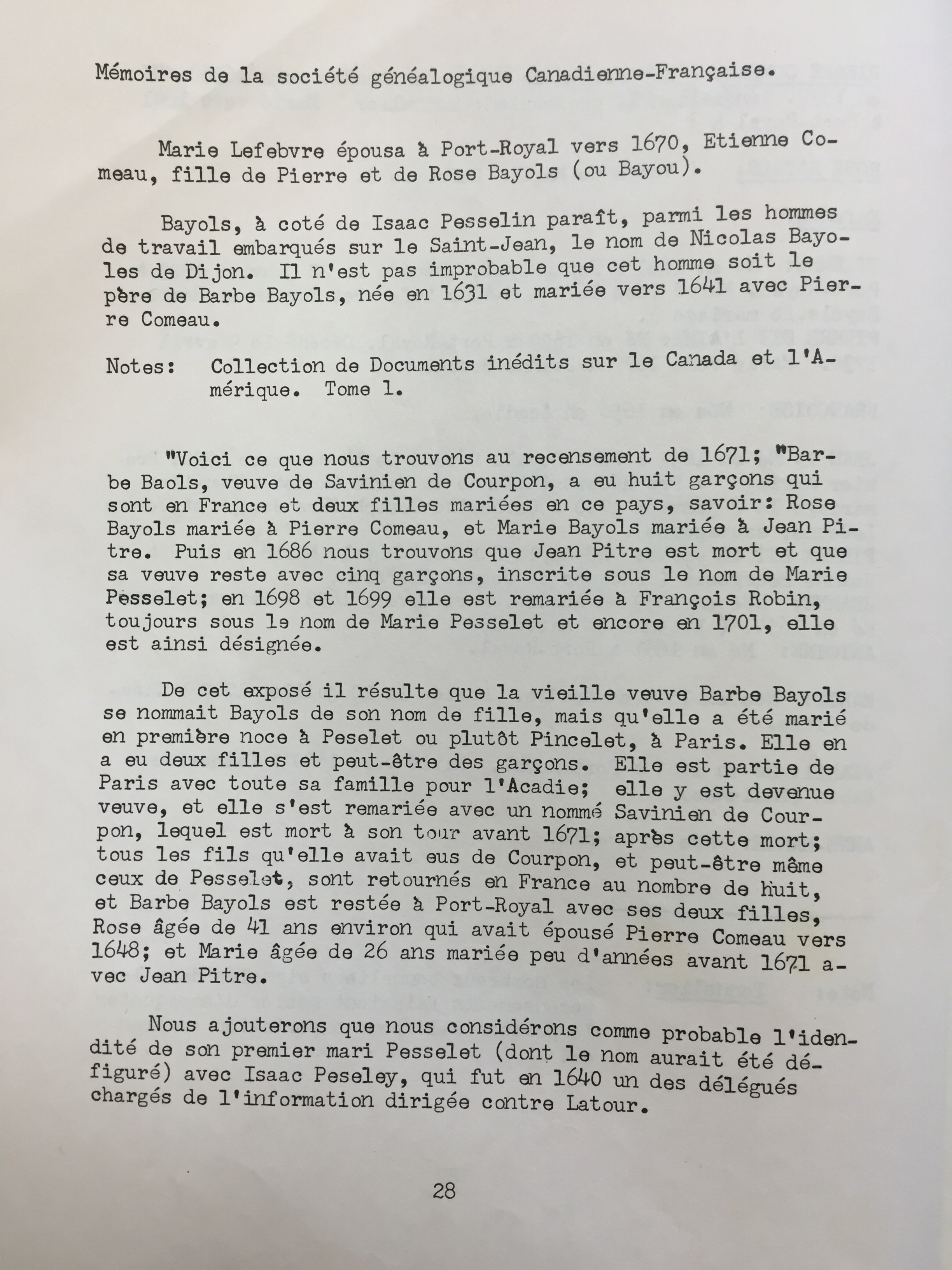
| Name | Rose Bayols |
| Date of Birth | 1631 |
| Place of Birth | Dijon, France |
| Place of Marriage | Port Royal |
| Date of Death | before 1686 |
| Place of Death | Port Royal |
| Daughter of & of |
Nicolas Bayols |
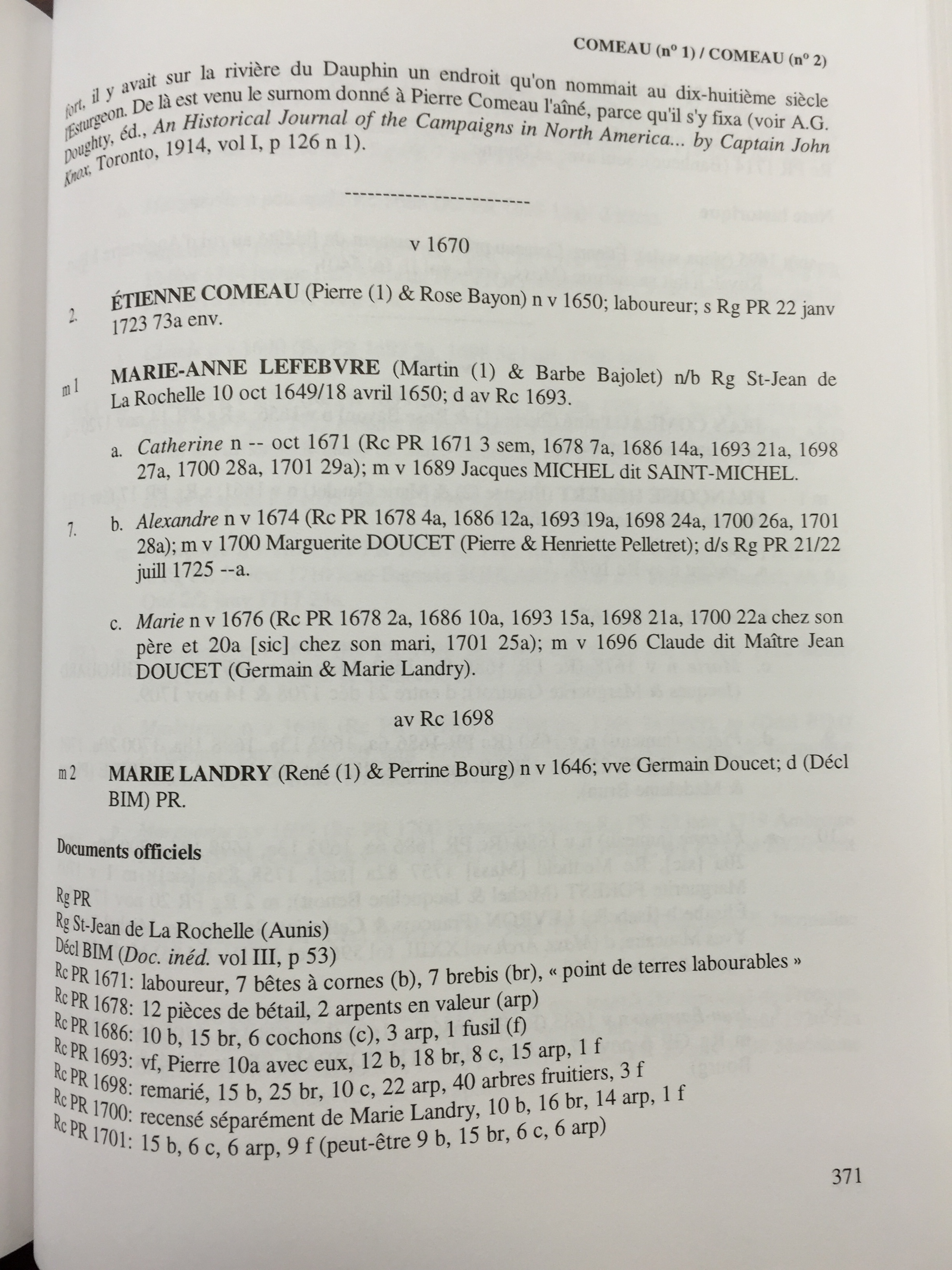
| Name | D.o.b | Place of Birth | D.o.d | Place of Death | Date of Marriage | Spouse |
|---|---|---|---|---|---|---|
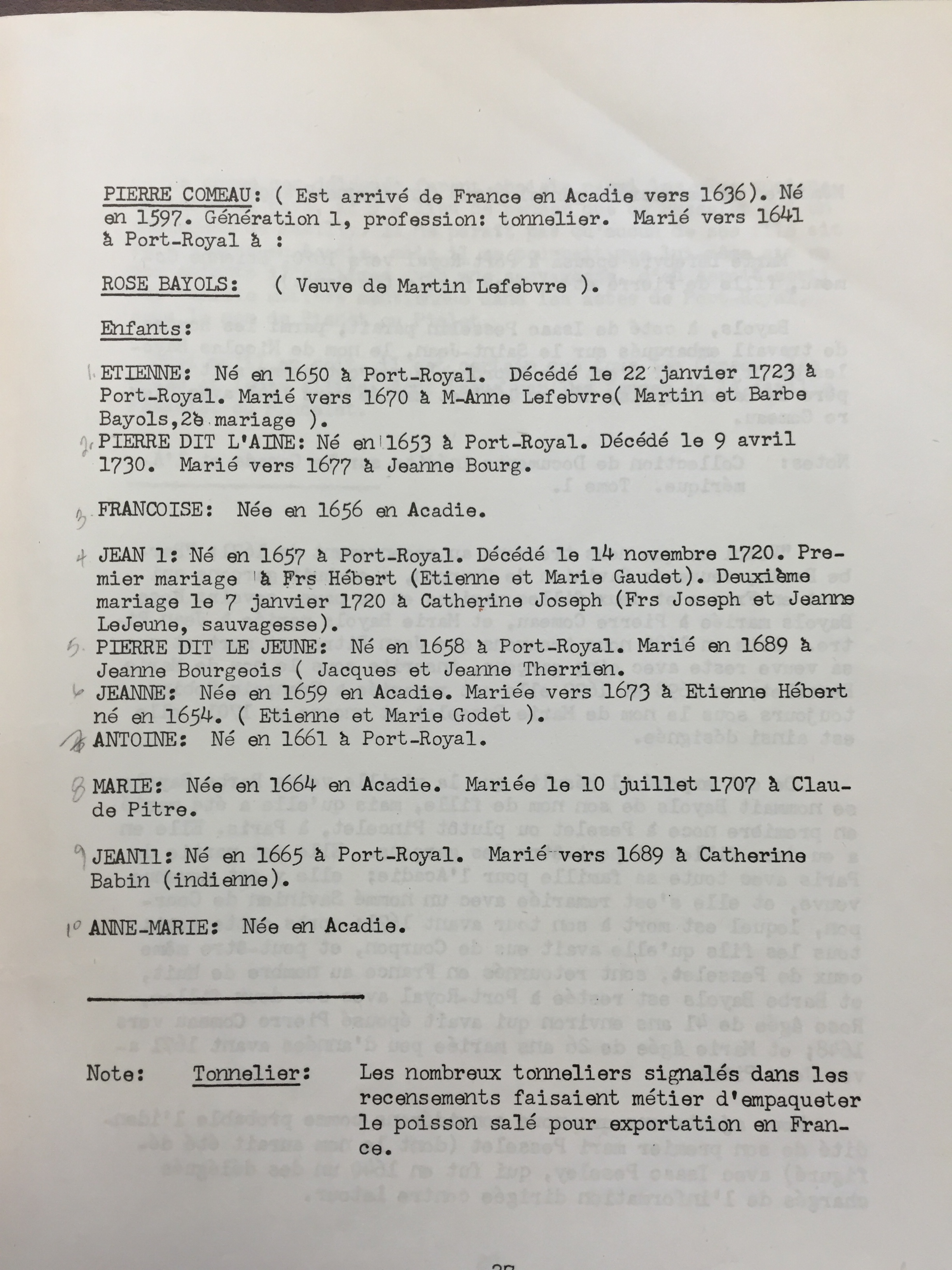
| Etienne | 1650 | Port Royal | 1723-01-23 | Port Royal | 1670 | Marie-Anne LeFevbre |
| Catherine | 1671-10 | Port Royal | 1689 | Jacques Michel | ||
| Alexandre | 1674 | Port Royal | 1700 | Marguerite Doucet | ||
| Marie | 1676 | Port Royal | 1696 | Claude Doucet | ||
| Une Fille | 1651 | Port Royal | ||||
| Pierre l'Esturgeon | 1653 | Port Royal | 1720-04-08 | 1677 | Jeanne Bourg | |
| Marie-Anne Comeau | ||||||
| Abraham Comeau | ||||||
| Marguerite Comeau | ||||||
| Anne Comeau | ||||||
| Marie Jeanne Comeau | ||||||
| Joseph Comeau | ||||||
| Pierre Comeau | ||||||
| Madelaine Comeau | ||||||
| Angélique Comeau | ||||||
| Catherine Comeau | ||||||
| Elisabeth Comeau | ||||||
| Françoise Comeau | ||||||
| Cecile Comeau | ||||||
| Jean Comeau | ||||||
| François Comeau | ||||||
| Maurice Comeau | ||||||
| Ambroise Comeau | ||||||
| Jacques Comeau | ||||||
| Anne-Marie | 1654 | Port Royal | 1677 | Etienne Rivet | ||
| Francoise | 1656 | Port Royal | 1713 | Port Royal | 1677 | Jean Gaudet |
| Françoise Gaudet | ||||||
| Jean Gaudet | ||||||
| Jean | 1657 | Port Royal | 1720-11-03 | Port Royal | 1679 1720 |
Francoise Hébert Catherine Joseph (indigenous) |
| child | c. 1678 | Port Royal | ||||
| child | c. 1678 | Port Royal | ||||
| Marie | c. 1678 | Port Royal | c. 1709 | 1697 | Pierre Girouard | |
| Pierre (twin) | c. 1680 | Port Royal | c. 1709 | 1704-01-25 | Susanne Joan Bezier Larivière | |
| Étienne (twin) | c. 1680 | Port Royal | c. 1709 | Elisabeth Isabelle Levron | ||
| Jean-Baptiste | c. 1683 | Port Royal | c. 1709 | 1713-11-06 | Anne-Marie Thibodeau | |
| Anne | c. 1686 | Port Royal | c. 1709 | 1708-01-17 | Louis D'Amour de Chauffours | |
| Marguerite | c. 1686 | Port Royal | ||||
| Augustin | c. 1688 | Port Royal | 1714-02-12 | Jeanne Levron Nantois | ||
| Claude | c. 1690 | Port Royal | ||||
| Francois | c. 1691 | Port Royal | 1715-01-07 | Marie-Jeanne Soulard | ||
| Marie | c. 1693 | Port Royal | ||||
| Françoise | c. 1694 | Port Royal | 1710-02-10 | Jean-Baptiste Soulard | ||
| Alexandre | c. 1695 | Port Royal | 1722-01-17 | Marie Bertrand | ||
| Madeleine | c. 1698 | Port Royal | 1716-09-30 | Pierre Trahan | ||
| Marguerite | c. 1699 | Port Royal | 1723-01-23 | Ambroise Melanson | ||
| Marie-Charlotte | Port Royal | c. 1720 | Jean Trahan | |||
| Joseph | 1703 | Port Royal | 1736-08-13 1739-11-23 |
Brigitte Levron Madeleine Girouard |
||
| Anne-Judith | 1705-08-18 | Port Royal | 1726-02-26 1757-09-21 |
René Gisé des Rosiers Charles Richard |
||
| Françoise | 1720-11-22 | Port Royal | 1741-06-10 | Michel Daniel | ||
| Pierre Loups Marins | 1658 | Port Royal | 1740 | Port Royal | 1689 | Jeanne Bourgeois |
| Pierre Comeau | 1690-06-07 | Port Royal | 1706-07-28 | Port Royal | ||
| Ann Comeau | 1691 | Port Royal | 1713 | Port Royal | ||
| Françoise Comeau | 1692 | Port Royal | 1709-10-29 | Antoine Brun | ||
| Jeanne Comeau | c. 1698 | Port Royal | 1705-10-12 | Etienne Martin | ||
| Francois Comeau | 1701 | Port Royal | 1785 | St. Bernard NS | 1726 1763 |
Marie Madelein L'Or Madeleine Pitre |
| Pierre Comeau | 1705-07-27 | Port Royal | 1785 | Port Royal | ||
| Alexandre Comeau | 1707 | Port Royal | 1715 | Port Royal | ||
| Medeleine Comeau | 1713 | Port Royal | ||||
| Jeanne Comeau | 1715-11-27 | Charles Martin | ||||
| Jeanne | 1659 | Port Royal | Rivè re-aux-Canards | 1673 | Etienne Hébert | |
| Antoine | 1661 | Port Royal | ||||
| Mary Coombs | 1689 | Salem, Mass | ||||
| Peter Coombs | 1691 | Salem, Mass | ||||
| Tabitha Coombs | 1693 | Wenham | ||||
| Anthony Coombs | 1695 | Salem, Mass | ||||
| John Coombs | 1699-03-18 | Rochester, Mass | ||||
| Hannah Coombs | 1700-11-30 | Rochester, Mass | ||||
| Rosanna Coombs | 1702-11-23 | Rochester, Mass | ||||
| Ithamer Coombs | 1704-11-20 | Rochester, Mass | ||||
| Joshua Coombs | 1706-07-23 | Rochester, Mass | ||||
| Frances Coombs | 1708-07-20 | Rochester, Mass | ||||
| Jane Coombs | 1710-03-29 | Rochester, Mass | ||||
| Marie | 1664 | Port Royal | 1707-07-10 | Claude Pitre | ||
| Jean | 1665 | Port Royal | 1689 | Catherine Babin (indigenous) |
https://www.wikitree.com/wiki/Comeau-17
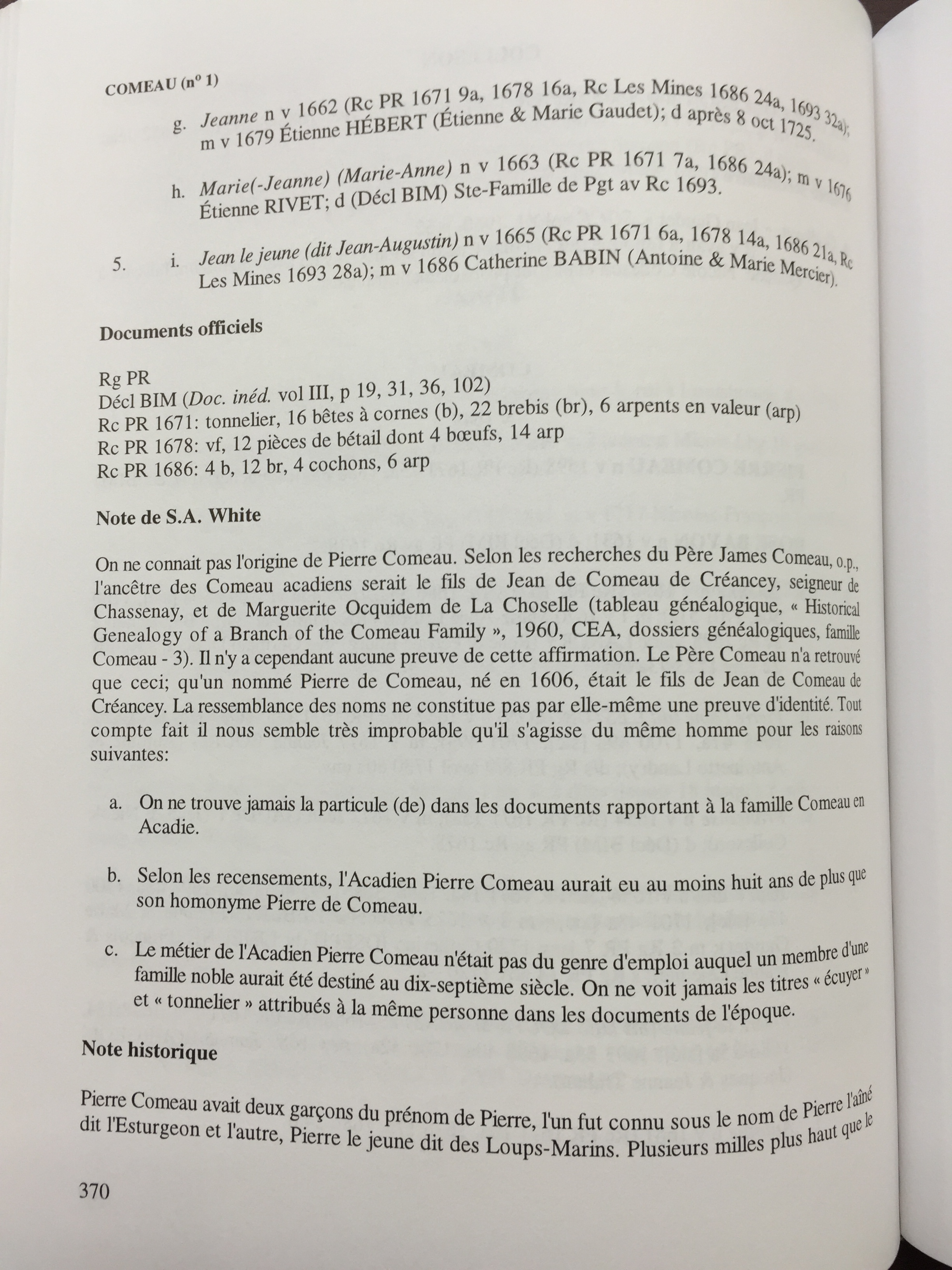
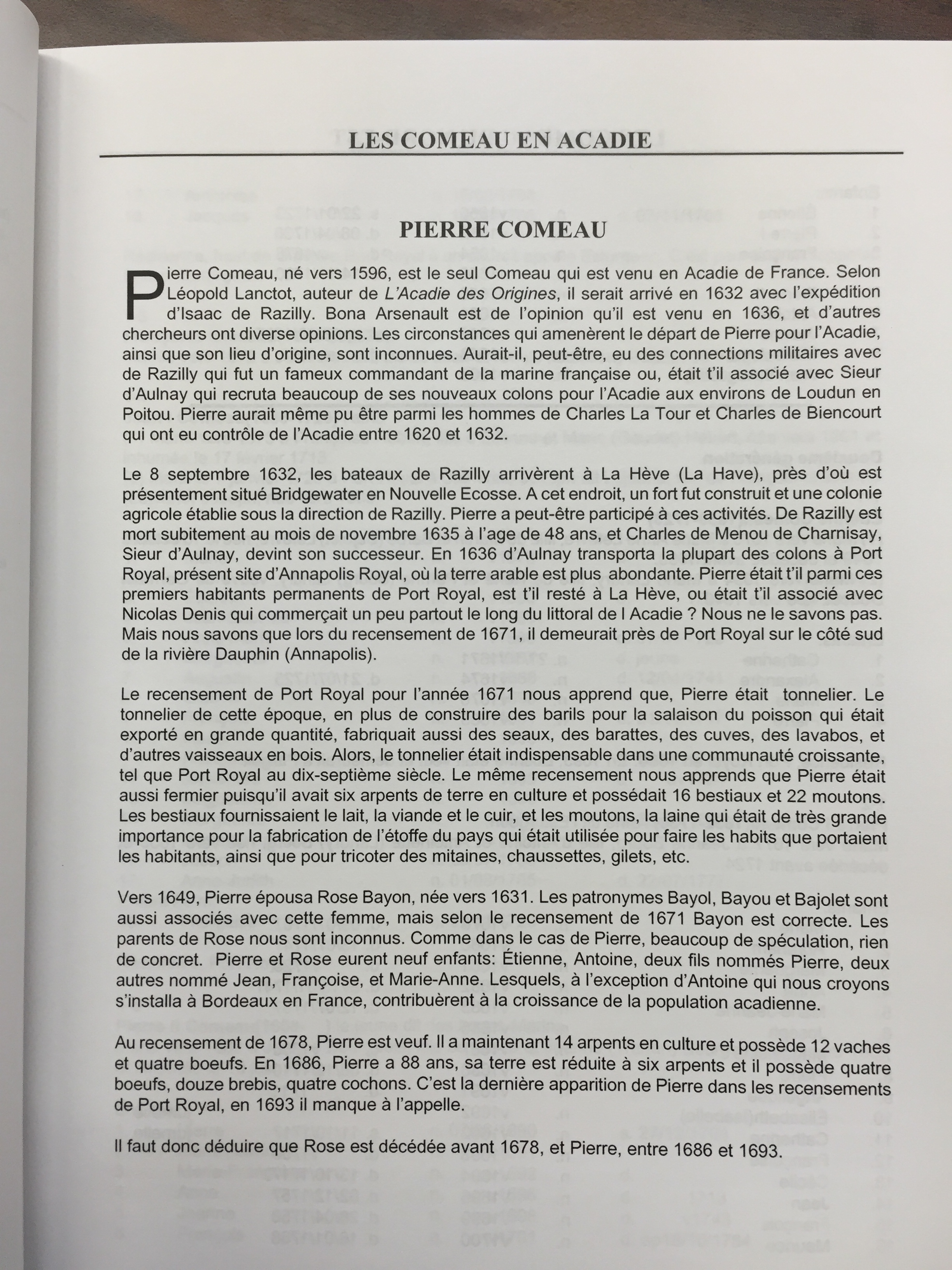
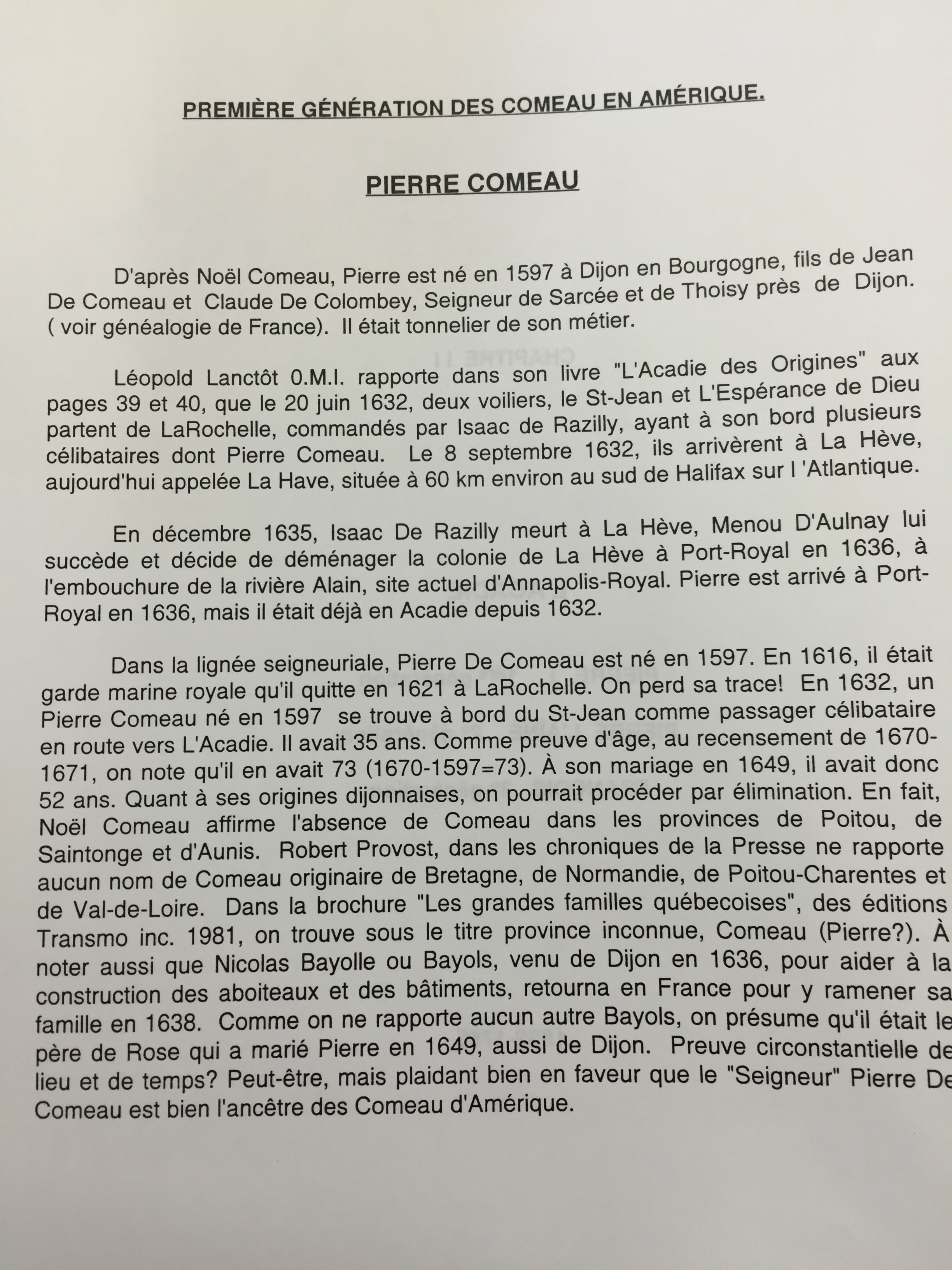
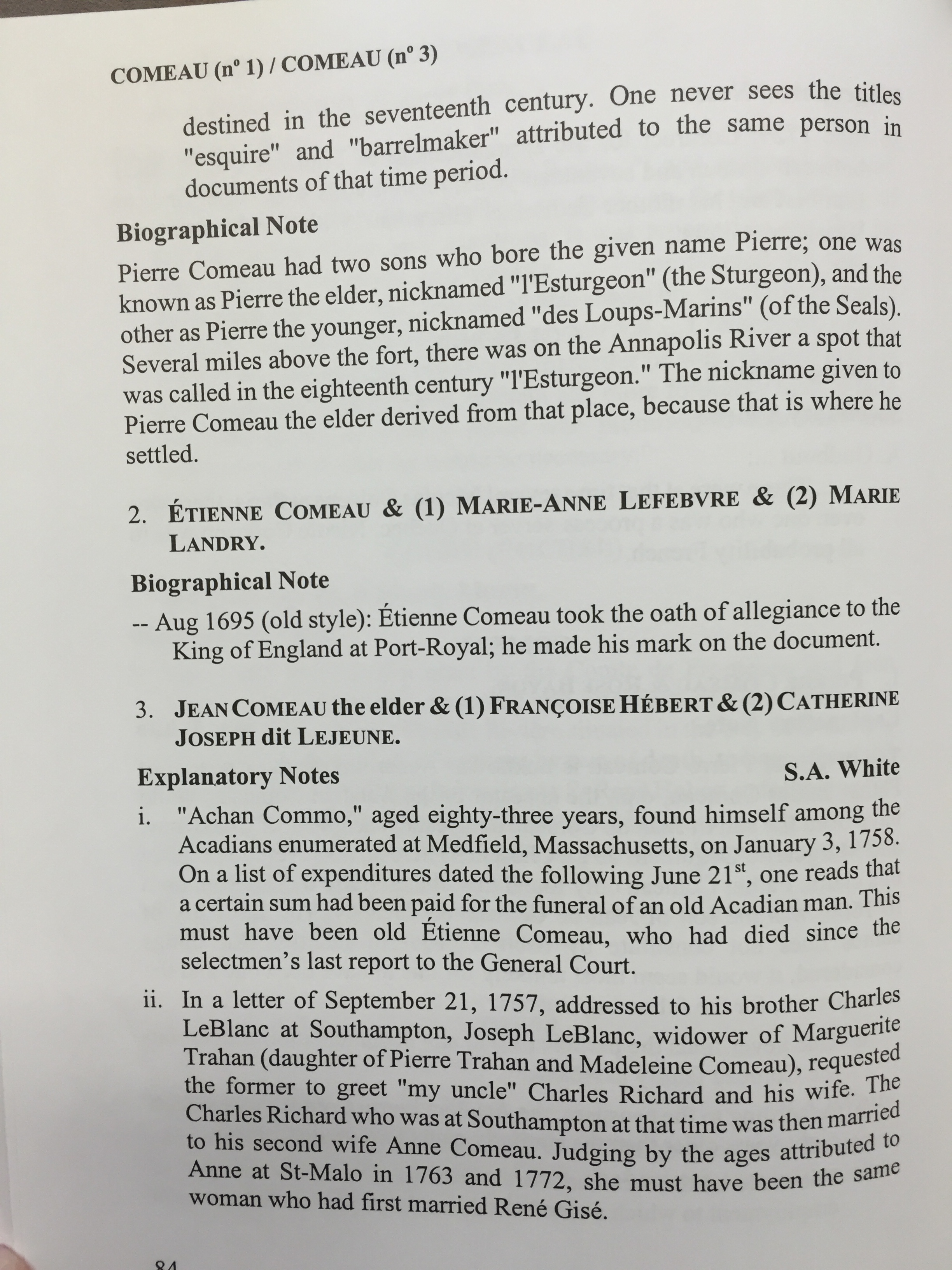
Pierre Comeau is universally recognized as the direct ancestor of the Comeaus of North America, though his origins remain uncertain. In the twentieth century, Father James Comeau, O.P., attempted to trace Pierre's roots and linked him to the Comeau family of the Dijon area, in Pouilly-en-Auxois — arguing that Pierre was a lost son of this line, minor nobility who served as mayors of Dijon in the seventeenth century, and whose lineage can be traced back to a Hubert Comeau born in 1363. This Dijon connection should be treated with skepticism.
Later in the twentieth century, Jacques A. Comeau undertook his own research into Pierre's origins, but his findings were inconclusive. One lead from that research, however, deserves closer attention: a possible connection between Pierre and the maritime world of France's north Atlantic coast2.
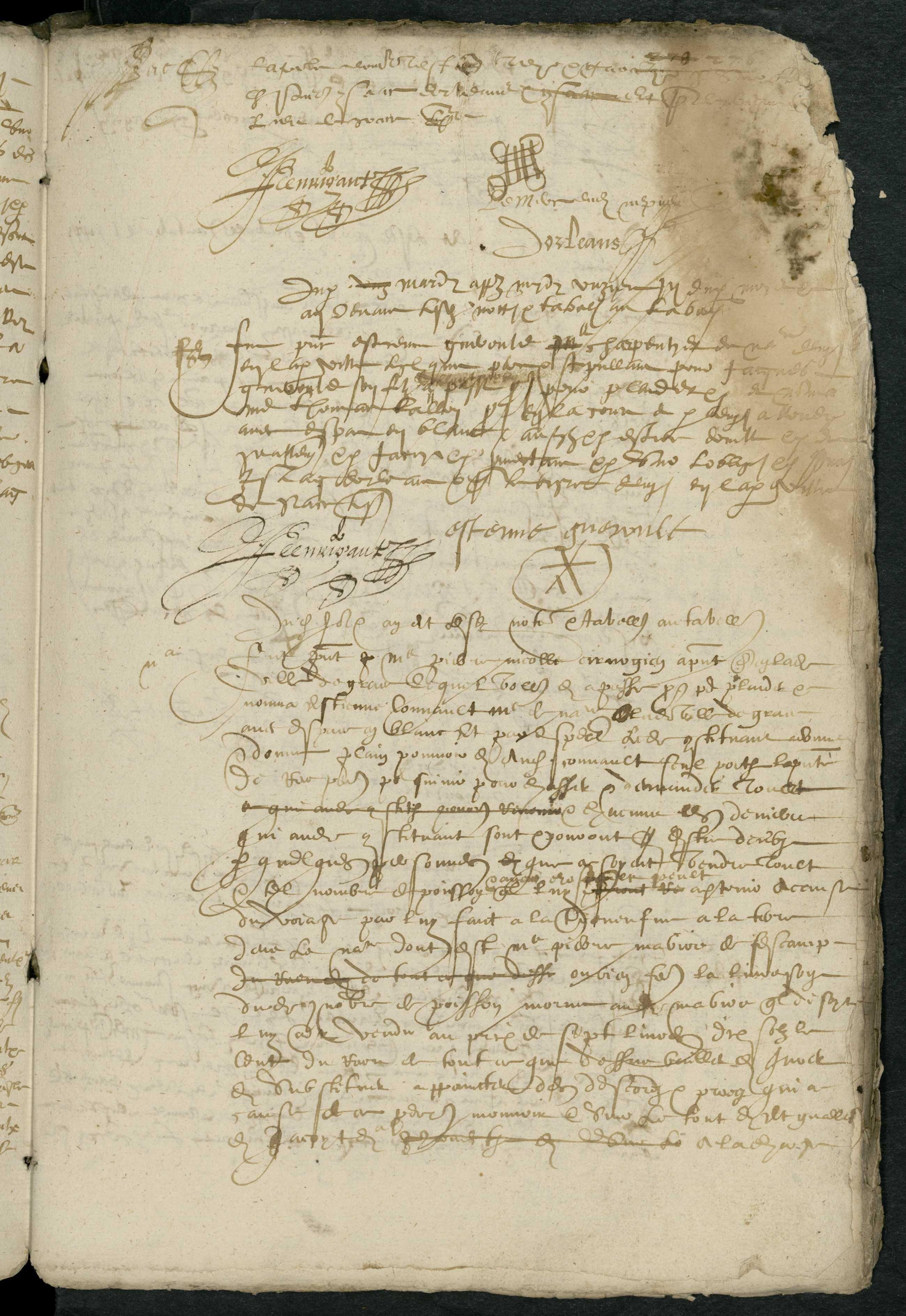
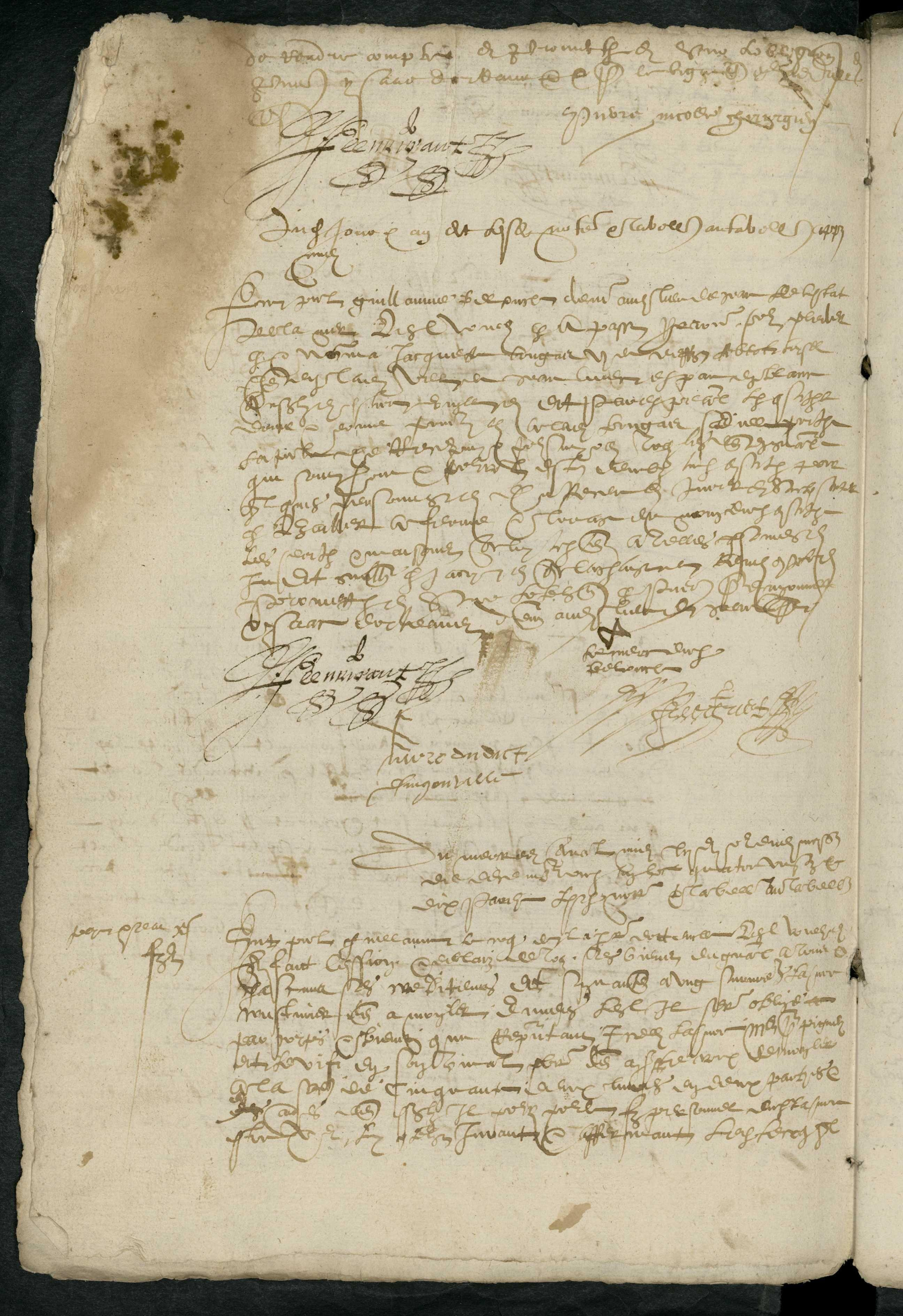
Jacques uncovered a notarial record dated December 11, 1590, concerning an Estienne Commault and the Newfoundland cod trade. The document shows Commault acting as a legal and commercial representative in connection with the proceeds of a Newfoundland fishing voyage. The surviving copy is difficult to read in places, but its substance is clear: Commault was entrusted to act on another man's behalf in matters involving fish, goods, debts, accounts, or the proceeds of the voyage.
Surname spelling was still fluid at this time. Names were typically recorded phonetically by whichever clerk, priest, or notary happened to be writing them down, in a society where literacy was uneven and spelling had not yet been standardized. As a result, related forms such as Commault, Commaulx, Comaux, and Comeau appear interchangeably across early modern records. The 1590 spelling should not be dismissed simply because it differs from the modern one.
What matters most here is the social and commercial role the document implies. Estienne Commault was not a minor or incidental figure — he appears as someone trusted to handle legal and financial matters tied to an Atlantic voyage. A procurator or commercial agent needed to be someone whose word and actions merchants, shipmasters, debtors, and notaries alike would recognize and honor. Such a role implies practical competence, reliability, and a measure of standing within the maritime-commercial world of northern France.
This fits the broader history of the Newfoundland fishery. By the sixteenth century, French crews from Normandy, Brittany, and the Basque country were sailing across the Atlantic each season to fish for cod and, in some regions, to hunt whales. The Canadian Museum of History notes that by around 1550, hundreds of French ships were already making the crossing. Newfoundland and Labrador Heritage similarly notes that France dominated the transatlantic migratory fishery through much of the sixteenth and seventeenth centuries, with most fishers coming from Brittany and Normandy — regions with the ports, expertise, and markets the cod trade required. Newfoundland was not yet a settled colony, but it was already a working maritime zone: men crossed the Atlantic for the fishing season, cod was preserved for European markets, and legal and commercial affairs continued back in France through agents, notaries, creditors, and representatives.
Seen in this light, the 1590 record matters not because it proves a direct genealogical link to the later Acadian Comeaus, but because it places a man bearing a closely related surname squarely within the Atlantic-maritime world from which such a connection could plausibly have emerged. It demonstrates that a Commault/Comaux/Comeau-type name existed within the French commercial networks tied to Newfoundland well before the Acadian settlement period. That is circumstantial evidence, not proof — but it is meaningful circumstantial evidence nonetheless.
Given all this, it is fitting that a cooper — a barrel maker — would go on to settle in colonial Nova Scotia roughly fifty years later. Pierre named his first son Étienne, which proves nothing on its own, but does suggest a family culture in which the names Pierre and Étienne passed regularly between fathers and sons. On balance, it seems more likely that the Acadian Pierre came from a family tied to fisheries, shipping, barrel-making, cod, and the Atlantic economy than that he descended from the inland Dijon family.
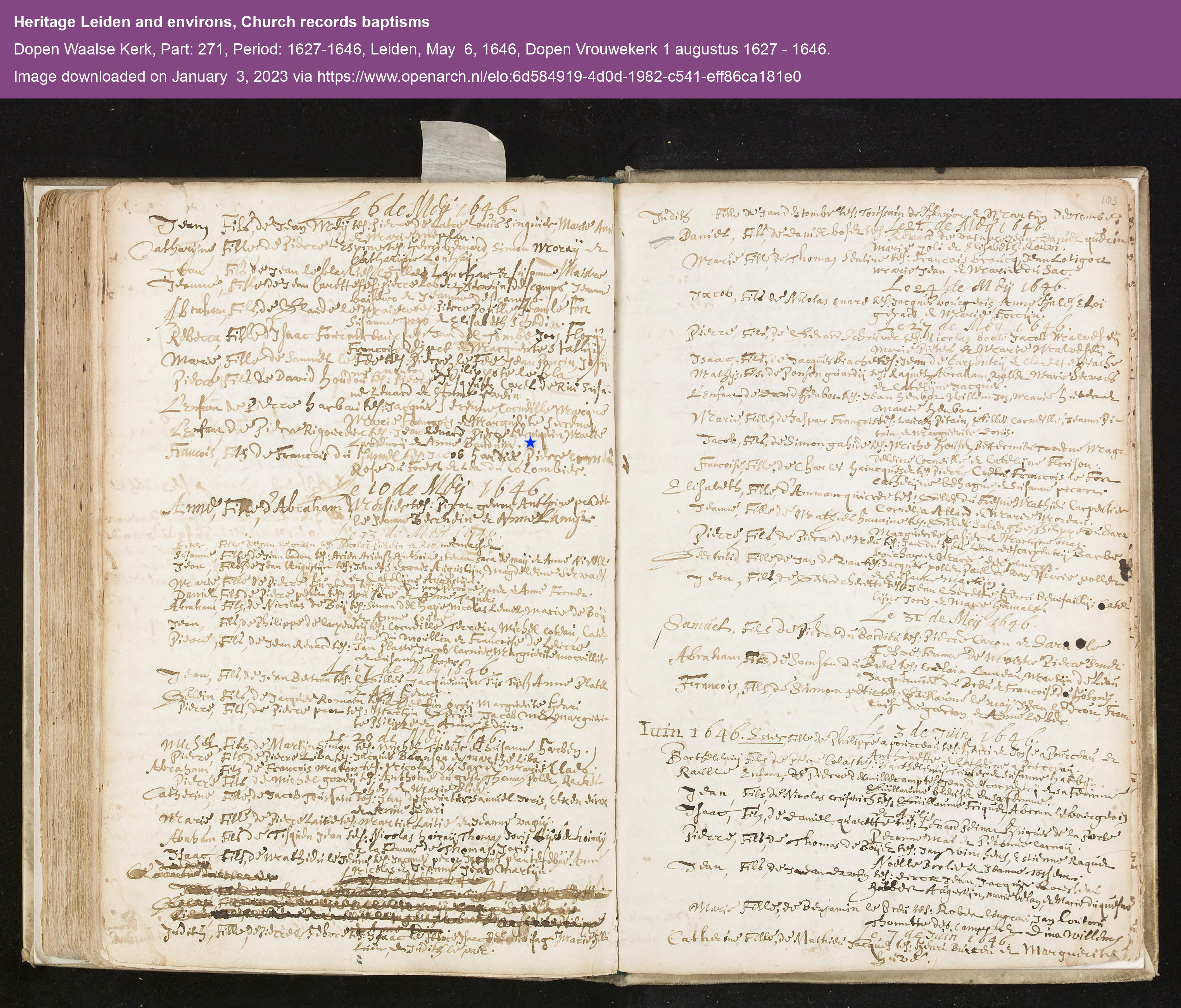
A further clue pointing toward northern France is the appearance of a Pierre Comeau as a witness to a baptism in Leiden, in the Netherlands, on May 6, 1646. This Pierre is almost certainly not the Acadian Pierre, but his presence is still worth noting. The records of this Walloon church generally belong to French-speaking Reformed communities — Walloons from the southern Low Countries as well as Huguenots and other French-speaking Protestants from France. The Walloon Index was created to catalogue baptismal, marriage, membership, and death records from French Protestant churches in the Netherlands, and it also includes some French-speaking individuals found in Dutch Reformed registers. The Dutch genealogical centre CBG describes the Bibliothèque Wallonne Leiden collection as an index of baptism, marriage, and burial records from Walloon communities in the Netherlands, Belgium, France, and Germany, covering material from roughly 1500 onward. The Leiden record matters because it places the Comeau name — or a closely related form of it — within a northern European, French-speaking, Protestant or Walloon milieu during the same broad period. It suggests that people bearing the name may have moved through the same Channel, North Sea, and northern French networks that connected ports, refugees, merchants, tradesmen, and religious communities.
Even so, this Huguenot and Walloon context should be treated as a research clue rather than a conclusion. The sixteenth and seventeenth centuries were marked by religious conflict, migration, and shifting identities. French-speaking Protestants moved into the Dutch Republic, England, the Channel Islands, and other places where Reformed communities could survive. Some families split along confessional lines; others outwardly conformed in one place while maintaining ties elsewhere. A later Catholic Acadian family could still have had earlier Protestant collateral branches, or could simply have shared a surname with related families moving through different religious worlds.
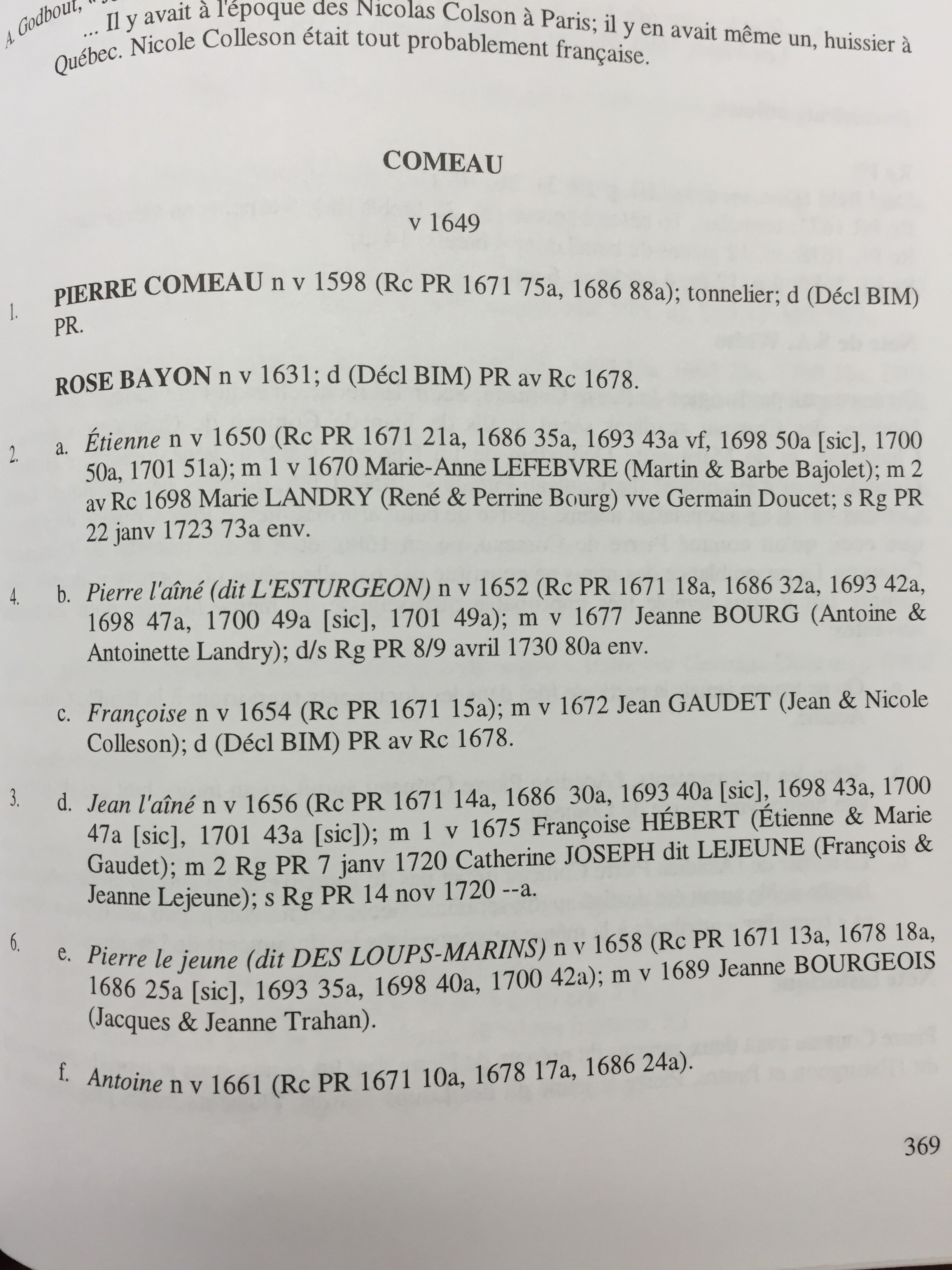
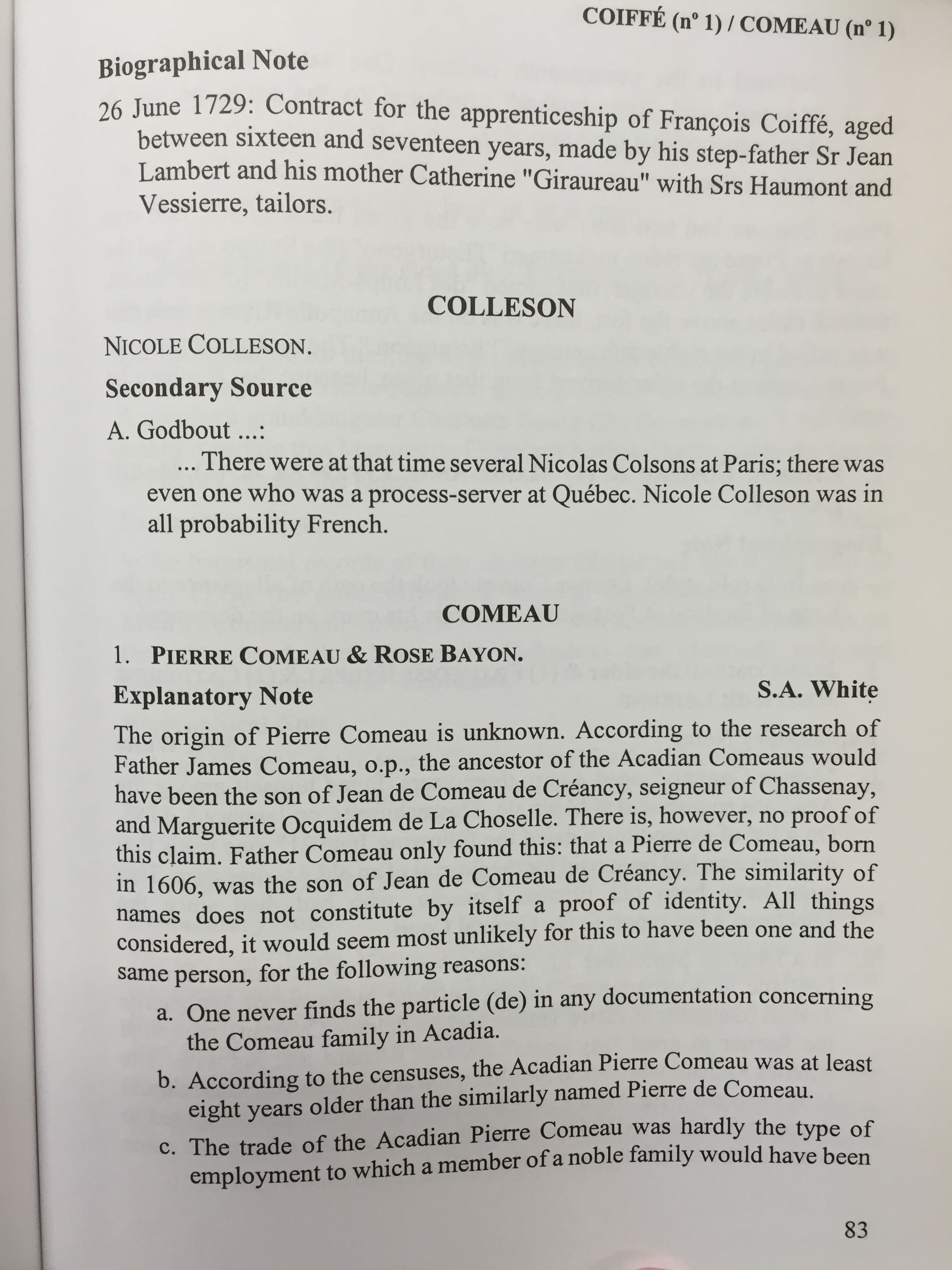
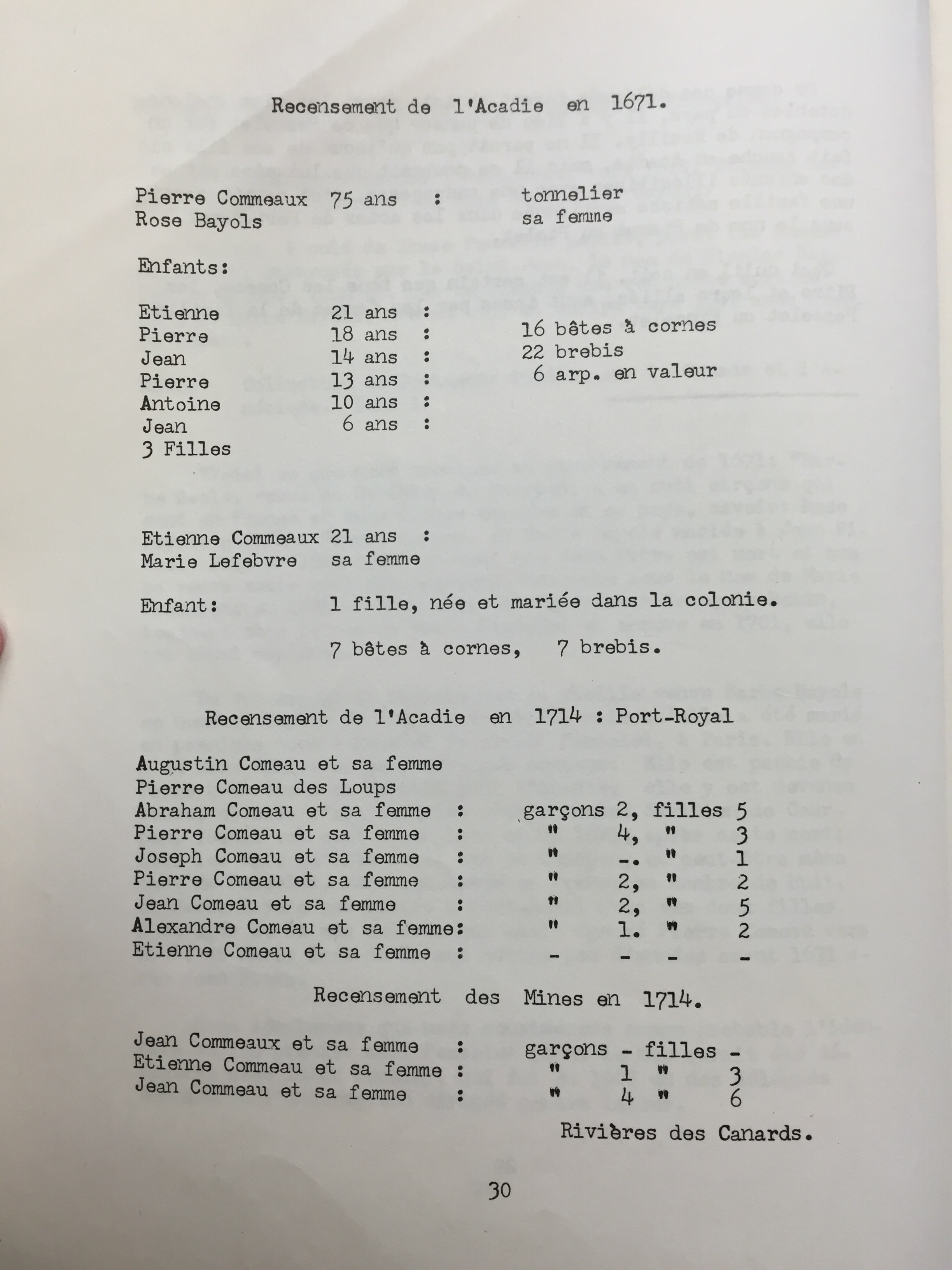
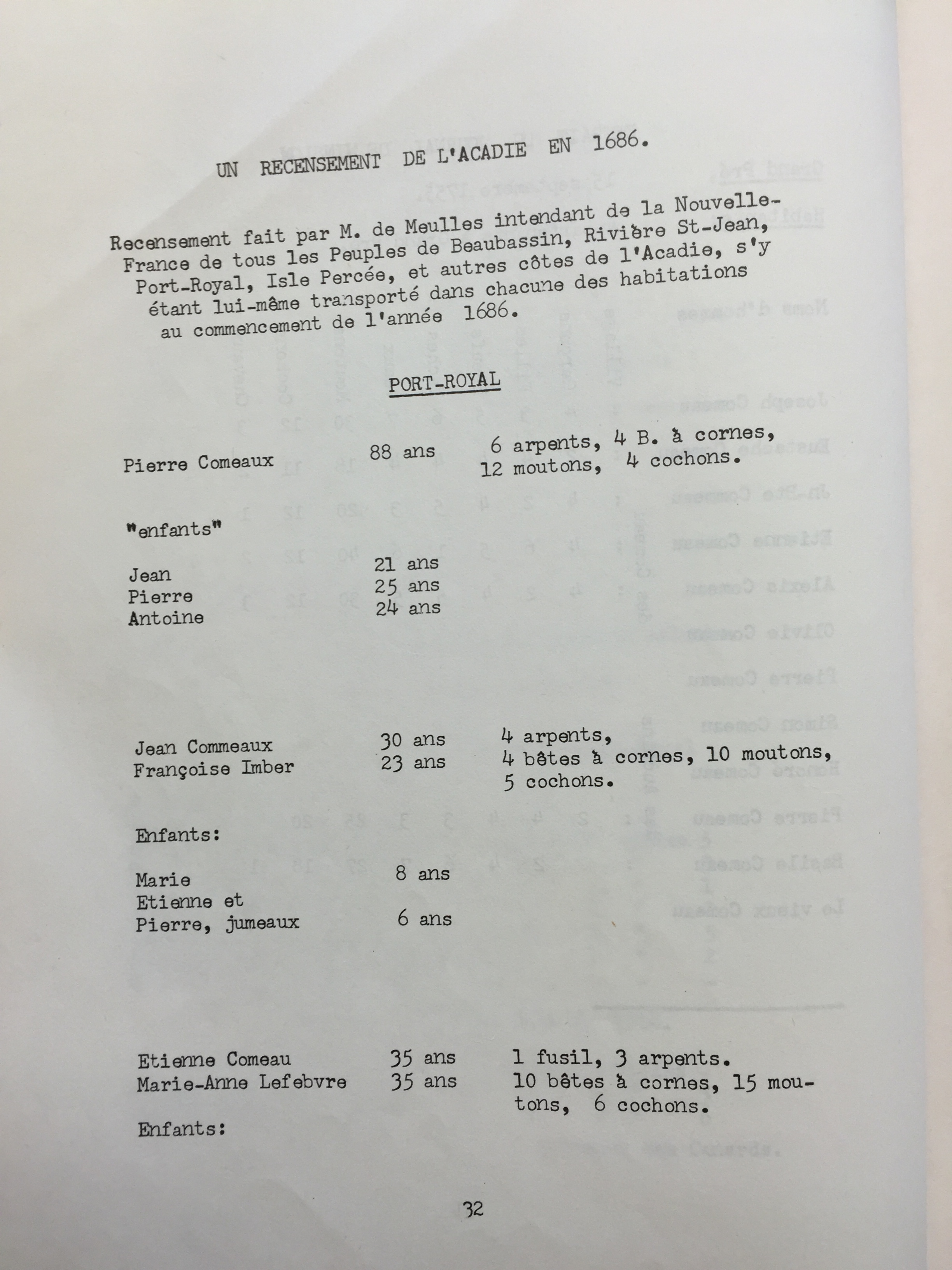
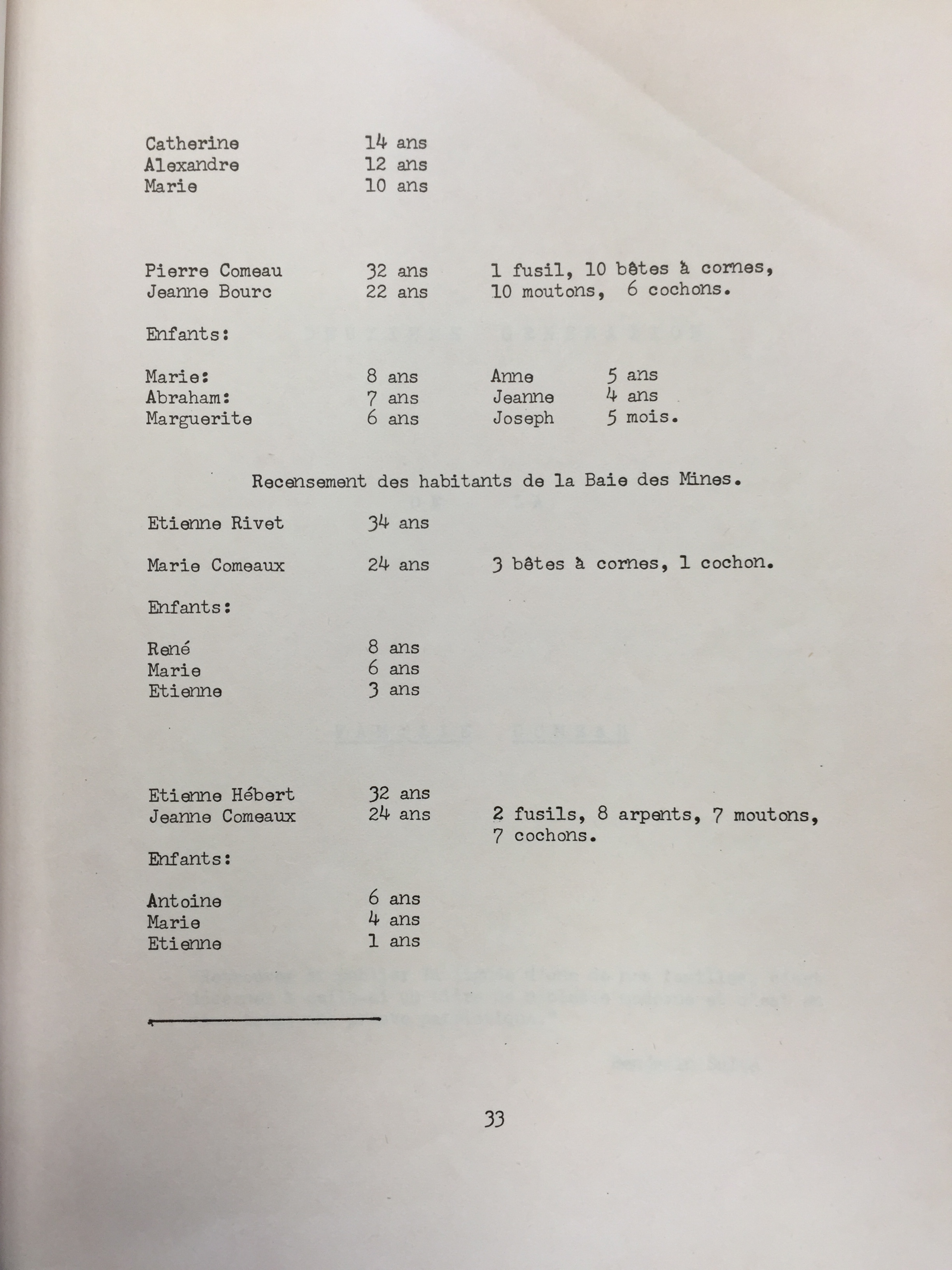
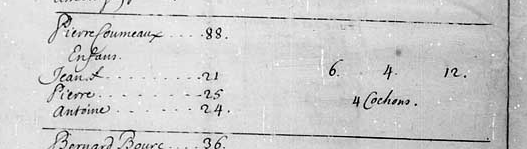
What we know of Pierre comes largely from census records of the last quarter of the seventeenth century, which place his birth year around 1596–1598. Pierre married Rose Bayols (also written Bayons) around 1649. Her father, Nicolas Bayols/Bayons, is associated with the ship St. Jehan. Pierre first appears clearly in the Acadian record in the 1671 census, reproduced below. By then he was already an older man with a younger wife and children — suggesting he may have lived a long earlier life in Europe before founding the Acadian family from which the North American Comeaus descend.
In 2014, a genealogist established that Anthony Combs of New England was in fact Antoine Comeau, a son of Pierre who disappears from the Acadian records after moving to New England. His descendants later wrote a memoir. See Antoine's record for details.
1."Father James Comeau O.P.'s thorough research in France has fairly well established the origins of Pierre at Dijon, France, where the Comeau family was well established and where the ancestral chateau still stands, inhabited by relatives of the Comeau family. Father James Comeau O.P. traced the ancestry of Pierre de Comeau, who came to Acadia to Guy de Comeau, Lord of Creancy, born around 1450. Mr. and Mrs. Jean-Denis Comeau traced it further to Hubert de Comeau, born around 1360." J. Alphone Deveau The Comeau Family of Saint Mary's Bay, self-published, 1989. Father James was of the "Order of Preachers" (Dominicans).
2. The Etienne Commault speculation comes from the research done by Jacques A. Comeau; Comeau - a family name an ancestor. Ste-Therese QC. 1998, and online.
2. The pertinent documents were provided by his daughter Janet Comeau and sourced to the Seine-Maritime Departmental Archives in Rouen France with the help of archivist Justine Ledoux. Reference number 2 E 70/66 (a register from the notary's office of Le Havre). DIRECT LINK pages 566 & 577
The Netherlands Register is reproduced below and the direct link: HERE
Pierre Comeau est universellement reconnu comme l'ancêtre direct des Comeau d'Amérique du Nord, bien que ses origines demeurent incertaines. Au XXe siècle, le père James Comeau, o.p., a tenté de retracer les origines de Pierre et l'a rattaché à la famille Comeau de la région de Dijon, à Pouilly-en-Auxois — soutenant que Pierre était un fils oublié de cette lignée, une petite noblesse ayant occupé la fonction de maires de Dijon au XVIIe siècle, et dont la filiation remonterait jusqu'à un certain Hubert Comeau, né en 1363. Ce lien avec Dijon doit être considéré avec prudence.
Plus tard au XXe siècle, Jacques A. Comeau a mené ses propres recherches sur les origines de Pierre, mais ses conclusions sont demeurées incertaines. L'une des pistes issues de ce travail mérite toutefois qu'on s'y attarde : un lien possible entre Pierre et le monde maritime de la côte atlantique du nord de la France.
Jacques a découvert un acte notarié daté du 11 décembre 1590, concernant un certain Estienne Commault et le commerce de la morue à Terre-Neuve. Le document montre Commault agissant comme représentant juridique et commercial relativement aux profits d'une expédition de pêche à Terre-Neuve. La copie conservée est difficile à lire par endroits, mais le fond en est clair : Commault avait reçu mandat d'agir au nom d'un autre homme dans des affaires touchant le poisson, les marchandises, les dettes, les comptes ou les profits du voyage.
L'orthographe des noms de famille demeurait encore instable à cette époque. Les noms étaient généralement transcrits de façon phonétique par le greffier, le prêtre ou le notaire qui les consignait, dans une société où l'alphabétisation était inégale et où l'orthographe n'avait pas encore été normalisée. C'est pourquoi des formes apparentées comme Commault, Commaulx, Comaux et Comeau apparaissent de façon interchangeable dans les registres du début de l'époque moderne. La graphie de 1590 ne devrait donc pas être écartée simplement parce qu'elle diffère de la forme moderne.
Ce qui importe surtout ici, c'est le rôle social et commercial que suggère le document. Estienne Commault n'était pas une figure secondaire ou accessoire : il apparaît comme une personne de confiance, chargée de régler des affaires juridiques et financières liées à une expédition atlantique. Un procureur ou agent commercial devait être quelqu'un dont la parole et les actes étaient reconnus par les marchands, les capitaines, les débiteurs et les notaires. Un tel rôle suppose une compétence pratique, une fiabilité et une certaine position au sein du monde maritime et commercial du nord de la France.
Ce constat s'inscrit dans l'histoire plus large de la pêche à Terre-Neuve. Dès le XVIe siècle, des équipages français venus de Normandie, de Bretagne et du Pays basque traversaient l'Atlantique chaque saison pour pêcher la morue et, dans certaines régions, chasser la baleine. Le Musée canadien de l'histoire souligne que dès 1550 environ, des centaines de navires français effectuaient déjà la traversée. Le site Newfoundland and Labrador Heritage rapporte de même que la France a dominé la pêche migratoire transatlantique pendant une bonne partie des XVIe et XVIIe siècles, la majorité des pêcheurs provenant de Bretagne et de Normandie — régions dotées des ports, du savoir-faire et des marchés nécessaires au commerce de la morue. Terre-Neuve n'était pas encore une colonie établie, mais c'était déjà une zone maritime active : les hommes traversaient l'Atlantique pour la saison de pêche, la morue était conservée pour les marchés européens, et les affaires juridiques et commerciales se poursuivaient en France par l'intermédiaire d'agents, de notaires, de créanciers et de représentants.
Vu sous cet angle, l'acte de 1590 importe non pas parce qu'il prouve un lien généalogique direct avec les Comeau acadiens qui suivront, mais parce qu'il situe un homme portant un nom de famille étroitement apparenté au cœur même du monde maritime atlantique d'où un tel lien aurait pu plausiblement émerger. Il démontre qu'un nom du type Commault/Comaux/Comeau existait déjà dans les réseaux commerciaux français liés à Terre-Neuve, bien avant la période de peuplement de l'Acadie. Il s'agit là d'un indice circonstanciel, non d'une preuve — mais un indice circonstanciel significatif tout de même.
Dans ce contexte, il est cohérent qu'un tonnelier — un fabricant de barils — se soit établi en Nouvelle-Écosse coloniale environ cinquante ans plus tard. Pierre a donné à son premier fils le prénom Étienne, ce qui ne prouve rien en soi, mais laisse entrevoir une culture familiale où les prénoms Pierre et Étienne se transmettaient régulièrement de père en fils. Tout bien considéré, il semble plus probable que le Pierre acadien soit issu d'une famille liée aux pêcheries, à la navigation, à la tonnellerie, à la morue et à l'économie atlantique, plutôt qu'il ne descende de la famille dijonnaise de l'intérieur des terres.
Un autre indice pointant vers le nord de la France est la présence d'un Pierre Comeau comme témoin lors d'un baptême à Leyde, aux Pays-Bas, le 6 mai 1646. Il ne s'agit presque certainement pas du Pierre acadien, mais sa présence mérite tout de même d'être signalée. Les registres de cette église wallonne appartiennent généralement à des communautés réformées de langue française — des Wallons venus du sud des Pays-Bas, ainsi que des huguenots et autres protestants francophones venus de France. L'Index wallon a été créé pour répertorier les registres de baptême, de mariage, d'appartenance et de décès des églises protestantes françaises des Pays-Bas; il comprend également certains francophones retrouvés dans les registres réformés néerlandais. Le Centre généalogique néerlandais (CBG) décrit la collection de la Bibliothèque wallonne de Leyde comme un index des registres de baptême, de mariage et d'inhumation des communautés wallonnes des Pays-Bas, de Belgique, de France et d'Allemagne, couvrant des documents à partir d'environ 1500. Ce registre de Leyde importe parce qu'il situe le nom Comeau — ou une forme étroitement apparentée — dans un milieu nord-européen, francophone, protestant ou wallon, durant la même période générale. Il laisse supposer que des personnes portant ce nom auraient pu circuler dans les mêmes réseaux de la Manche, de la mer du Nord et du nord de la France, qui reliaient ports, réfugiés, marchands, artisans et communautés religieuses.
Ce contexte huguenot et wallon doit néanmoins être considéré comme une piste de recherche, et non comme une conclusion. Les XVIe et XVIIe siècles furent marqués par les conflits religieux, les migrations et les identités changeantes. Des protestants francophones se sont installés dans les Provinces-Unies, en Angleterre, dans les îles Anglo-Normandes et ailleurs, là où des communautés réformées pouvaient survivre. Certaines familles se sont scindées selon des lignes confessionnelles; d'autres se sont conformées en apparence à un endroit tout en conservant des liens ailleurs. Une famille acadienne catholique plus tardive aurait très bien pu avoir des branches collatérales protestantes antérieures, ou simplement partager un patronyme avec des familles apparentées évoluant dans des mondes religieux différents.
Ce que l'on sait de Pierre provient en grande partie des registres de recensement du dernier quart du XVIIe siècle, qui situent son année de naissance vers 1596-1598. Pierre a épousé Rose Bayols (aussi écrit Bayons) vers 1649. Son père, Nicolas Bayols/Bayons, est associé au navire Saint-Jehan. Pierre apparaît clairement pour la première fois dans les registres acadiens lors du recensement de 1671, reproduit ci-dessous. Il était alors déjà un homme âgé, marié à une épouse plus jeune et père de plusieurs enfants — ce qui laisse penser qu'il aurait pu mener une longue vie antérieure en Europe avant de fonder la famille acadienne dont descendent les Comeau d'Amérique du Nord.
En 2014, un généalogiste a établi qu'Anthony Combs, de la Nouvelle-Angleterre, était en réalité Antoine Comeau, un fils de Pierre qui disparaît des registres acadiens après son départ pour la Nouvelle-Angleterre. Ses descendants ont plus tard rédigé un mémoire. Voir la fiche d'Antoine pour plus de détails.
1. « Les recherches approfondies du père James Comeau, o.p., en France ont assez bien établi les origines de Pierre à Dijon, en France, où la famille Comeau était bien établie et où le château ancestral se dresse encore, habité par des parents de la famille Comeau. Le père James Comeau, o.p., a retracé la filiation de Pierre de Comeau, venu en Acadie, jusqu'à Guy de Comeau, seigneur de Créancy, né vers 1450. M. et Mme Jean-Denis Comeau l'ont retracée plus loin encore, jusqu'à Hubert de Comeau, né vers 1360. » — J. Alphonse Deveau, The Comeau Family of Saint Mary's Bay, autoédité, 1989. Le père James appartenait à l'Ordre des Prêcheurs (dominicains).
2. L'hypothèse concernant Estienne Commault provient des recherches de Jacques A. Comeau : Comeau — a family name an ancestor, Sainte-Thérèse (Québec), 1998, et en ligne.
3. Les documents pertinents ont été fournis par sa fille, Janet Comeau, et proviennent des Archives départementales de la Seine-Maritime, à Rouen, en France, avec l'aide de l'archiviste Justine Ledoux. Cote 2 E 70/66 (registre de l'étude notariale du Havre). LIEN DIRECT, pages 566 et 577.
Le registre néerlandais est reproduit ci-dessous, avec le lien direct : ICI.
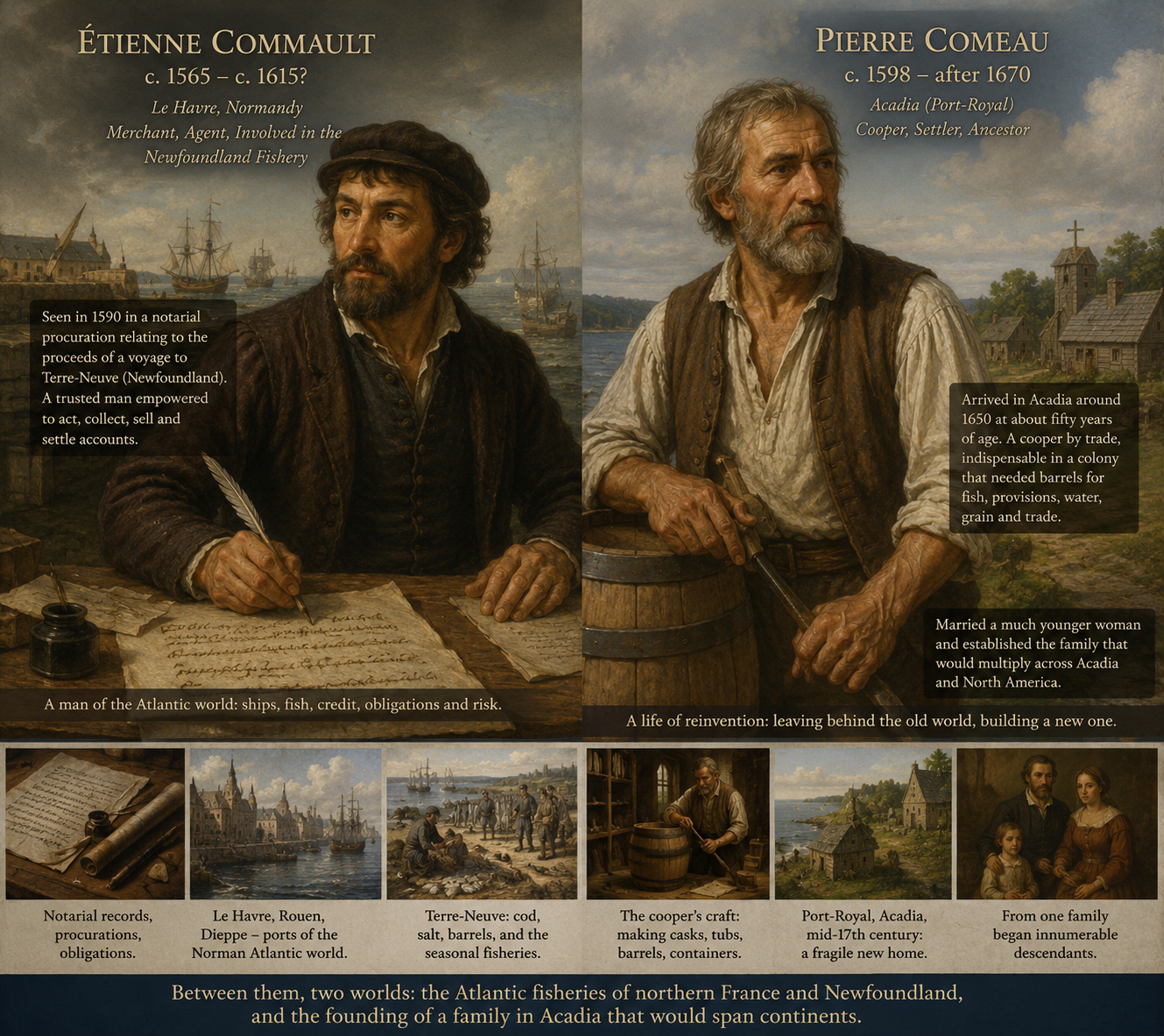
Here is a speculative illustration (ChatGPT generated, May 2026)
|
|
|
|
|
|
|
|
|
| Name | Profession | Age | Implied DOB | |
|---|---|---|---|---|
| Father | Pierre Commeaux | cooper | 75 | 1596 |
| Mother | Rose Bayols | wife | xx | |
| Etienne | 21 | 1650 | ||
| Pierre | 18 | 1653 | ||
| Jean | 14 | 1657 | ||
| Pierre | 13 | 1658 | ||
| Antoine | 10 | 1661 | ||
| Jean | 6 | 1665 | ||
| 3 girls | ||||
| Cattle | 16 | |||
| Sheep | 22 | |||
| Workable land | 6 arp | |||
| Name | Profession | Age | Implied DOB | |||
|---|---|---|---|---|---|---|
| Father | Pierre Commeaux | widower | ||||
| Pierre | 18 | 1660 | ||||
| Jean | 14 | 1664 | ||||
| Antoine | 17 | 1661 | ||||
| Jeanne | 16 | 1662 | ||||
| Cattle |
|
|||||
| Workable land | 14 arp | |||||
| 1 compass | ||||||
| Name | Profession | Age | Implied DOB | |
|---|---|---|---|---|
| Father | Pierre Commeaux | 88 | 1598 | |
| Jean | 21 | 1665 | ||
| Pierre | 25 | 1661 | ||
| Antoine | 24 | 1662 | ||
| Cattle | 4 | |||
| Pigs | 4 | |||
| Sheep | 12 | |||
| Workable land | 6 arp | |||
| Source Archives départementales de la Seine-Maritime, Registre du tabellionage du Havre. | |
![]() |
|
| page 566 2 E 70/66, 1590 | page 577 2 E 70/66, |
Source Open Archives Netherlands
|